
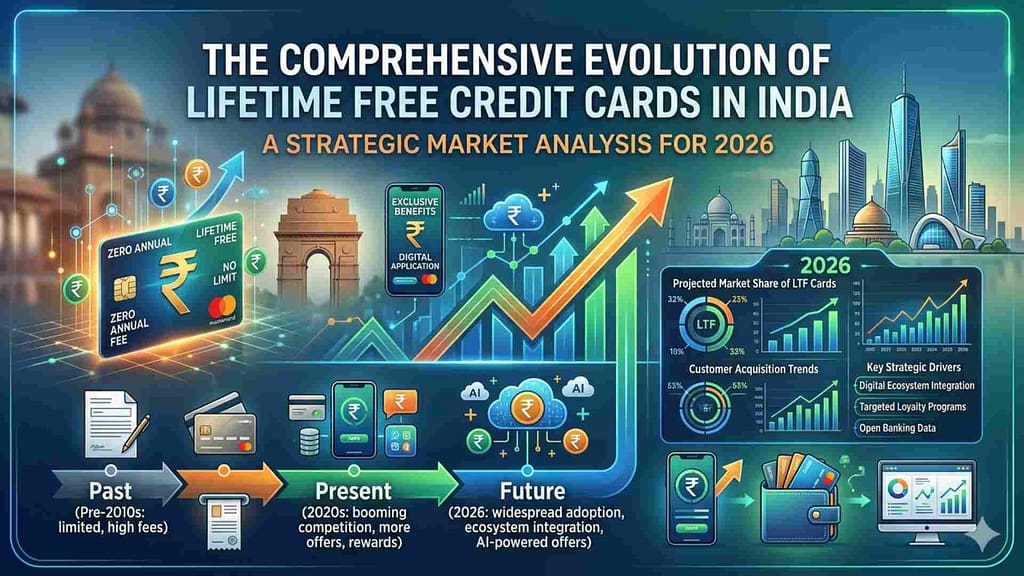
Why pay ₹500 to ₹1,000 every single year just for the privilege of holding a piece of plastic in your wallet? The short answer is: you really don’t have to.
Historically, credit cards with decent rewards forced you to pay an entry fee and an ongoing annual fee. However, the dynamics of India’s financial market have shifted dramatically. Entering 2026, the fierce competition among banks and fintech companies has resulted in a win for the consumer. Today, India offers some genuinely excellent credit cards that charge zero joining fees and zero annual fees—forever.
This comprehensive guide is designed to cut through the marketing noise and confusing jargon. We show you exactly which cards are worth space in your wallet, ensuring you maximize benefits without ever paying a fee.
Defining the Gold Standard: Truly Lifetime Free (LTF)
Before we dive into the specific cards, it is crucial to understand exactly what you are looking for. There is a massive, often expensive, difference between a card that is advertised as “free for the first year” and one that is truly lifetime free (LTF).
Many banks engage in marketing tactics where they waive the annual fee only if you hit a specific, sometimes high, spending target throughout the year. If you miss that target by even a single rupee, the fee is charged to your account automatically.
The cards selected for this list (with one notable exception identified below) are unconditionally free. That means no annual fees, regardless of how much or how little you use them. There are no minimum spend requirements to keep them active, and there are no hidden conditions attached to the fee waiver.
⚠️ A Warning on “Fake” Free Cards As a savvy consumer, you must always be on high alert. Many cards heavily advertise a “₹0 Joining Fee” to get you to sign up, but they quietly slip in a ₹500–₹1,000 renewal fee starting from Year 2 onwards. Before hitting apply on any offer, always scroll down to the important information document and specifically check the “Renewal Fee” or “Annual Fee” row—not just the “Joining Fee.”
All Cards at a Glance: Summary Table
Here is a quick overview of the top contenders in the market.
| Card | Best For | Top Benefit | Joining Fee | Annual Fee |
|---|---|---|---|---|
| Amazon Pay ICICI | Shopping | 5% cashback for Prime members | ₹0 | ₹0 |
| IDFC FIRST Millennia | All-round usage | 10X points on high spends | ₹0 | ₹0 |
| Axis Bank ACE* | Bill payments | 5% on utilities via GPay | ₹499* | ₹499* |
| Scapia Federal Bank | Travel | Zero forex + domestic lounges | ₹0 | ₹0 |
| Kiwi RuPay | UPI daily spends | Up to 5% cashback on UPI scans | ₹0 | ₹0 |
| IndusInd EazyDiner | Dining out | Up to 50% off at restaurants | ₹0 | ₹0 |
| IDFC FIRST Classic | Safety Net | Interest-free cash withdrawals | ₹0 | ₹0 |
| Kotak 811 | Beginners | FD-backed, no income proof | ₹0 | ₹0 |
Detailed Reviews: Which Card is Right for You?
1. Amazon Pay ICICI Credit Card: The King of Shopping
If you shop on Amazon even occasionally, this remains the undisputed king of free credit cards in India. With millions of users, it has defined the co-branded space. The definitive best part is that cashback is deposited automatically into your Amazon Pay balance as real cash at the end of every billing cycle. There are no points to calculate, no redemption fees to pay, and no expiry dates to worry about.
- Rewards: 5% for Prime members on Amazon, 3% for Non-Prime, 2% on partner brands, and 1% on all other spends.
- Pros: Unlimited cashback, automatic redemption, zero expiry, low forex markup (1.99%).
- Cons: Cashback is locked to the Amazon ecosystem, invite-only application, no airport lounge access.
2. IDFC FIRST Millennia Credit Card: The Best All-Rounder
If you want a single, free card that covers all bases without tying you to one specific shopping app, the IDFC FIRST Millennia is your best bet. A rare and highly valuable perk, even among premium paid cards, is that its reward points never expire.
- Rewards: 3X points on spends up to ₹20,000/month; 10X points on spends above that threshold.
- Pros: Points never expire, includes 4 railway lounge visits per quarter, works great across all platforms.
- Cons: No airport lounge access, 10X rewards only kick in after high spend, requires a good CIBIL score.
3. Axis Bank ACE Credit Card: The Utility Powerhouse
Disclaimer: Unlike the other cards on this list, Axis ACE usually carries a ₹499 annual fee. However, we have included it because Axis occasionally offers it as Lifetime Free during special promotions. If you find it LTF, grab it immediately.
If you pay a lot of utility bills (electricity, gas, broadband), the Axis ACE is phenomenal. By paying your bills through Google Pay, you get a massive flat 5% cashback. Given that every household pays these bills monthly, this card quietly saves you a significant amount of money over the year.
- Rewards: 5% on bills via GPay, 4% on Swiggy/Zomato/Ola, 1.5% on everything else.
- Pros: Industry-leading 5% cashback on essentials, high base cashback rate of 1.5%.
- Cons: Usually has an annual fee, the 5% rate is restricted to Google Pay, cashback is capped at ₹500/month.
4. Scapia Federal Bank RuPay Credit Card: The Essential Travel Companion
This has been the most talked-about travel card of the last few years. The premise is simple yet incredibly effective: zero forex markup. Most Indian cards charge a fee ranging from 2% to 3.5% whenever you swipe your card outside India or on a foreign website; Scapia charges nothing. Combined with domestic lounge access, it is an unbeatable travel companion for ₹0 annual fee.
- Rewards: 10–20% Scapia coins on spends, zero forex markup.
- Pros: Saves thousands on international trips, unlimited domestic lounge access (conditional), great app experience.
- Cons: Lounge access requires a minimum monthly spend, rewards are in “coins” rather than flat cash.
5. Kiwi RuPay Credit Card: The Best for UPI
Traditional credit cards rarely reward UPI transactions. Kiwi changed the game by building a card specifically for how India actually pays: scanning QR codes. By linking this RuPay card to a UPI app, you earn real cashback on UPI scans at your local kirana stores, cafes, and vendors.
- Rewards: Up to 5% cashback on UPI QR scans, 1% on regular card swipes.
- Pros: Earn rewards on daily local UPI spends, zero forex markup, links seamlessly to UPI apps.
- Cons: RuPay is not accepted on all international websites, cashback limits apply.
6. IndusInd Bank EazyDiner Platinum Card: For the Foodies
If you eat out or order in regularly, this card is an obvious lifestyle choice. Through the partnership with EazyDiner, this card offers up to 50% off at over 2,000 premium restaurants across India. It also includes a complimentary EazyDiner Prime membership—all for zero annual fees.
- Rewards: Up to 50% off dining bills, free EazyDiner Prime membership.
- Pros: Massive real-world savings for those who dine out frequently, Prime membership is worth ₹1,200/yr.
- Cons: Highly specific to dining; offers little value if you do not eat out.
7. IDFC FIRST Classic Credit Card: The Financial Safety Net
A hidden gem in the credit card world. The IDFC FIRST Classic allows interest-free cash withdrawals from ATMs for up to 48 days (only a small transaction fee applies)—a feature almost no other card in India offers. It also packs built-in roadside assistance.
- Rewards: Base reward points that never expire.
- Pros: Interest-free emergency ATM withdrawals, free roadside assistance, points do not expire.
- Cons: Lower reward rate than the Millennia variant, no lounge access.
8. Kotak 811 Dream Different Credit Card: Ideal for Beginners
If you are a student, a first-time earner, or someone looking to fix a broken CIBIL score, this is the starting block. This card is issued against a Fixed Deposit (FD). Because the bank holds your FD as security, they do not require income proof or a prior credit history for approval.
- Requirements: Minimum ₹10,000 FD. No income proof needed.
- Pros: Guaranteed approval, perfect for building or rebuilding a credit score safely.
- Cons: Your FD money is locked, very basic rewards, no premium features.
5 Common Mistakes People Make with Free Credit Cards
Even though these cards have no annual fees, they are still financial tools that must be used correctly. Avoid these common pitfalls:
- ❌ Confusing “Free First Year” with “Lifetime Free”: Always assume there is a fee unless you see the word “Lifetime” explicitly stated. Verify the renewal terms carefully.
- ❌ Paying Only the “Minimum Due”: A “free” card becomes incredibly expensive the moment you carry a balance. Interest rates on credit cards hover around 36–48% per year. Always pay the total amount due to keep the card truly free.
- ❌ Closing Old Cards: Keep your oldest free cards active, even if you rarely use them. Closing them reduces your credit history length and your overall available credit limit, both of which will temporarily hurt your CIBIL score.
- ❌ Assuming “Free” Means “Basic”: Just because you are not paying a fee does not mean you should accept sub-par benefits. As shown in this list, cards like Scapia offer premium features like lounge access for ₹0.
- ❌ Spending Just to Earn Rewards: Cashback and points are a bonus on money you already planned to spend. Overspending just to earn rewards defeats the entire purpose of trying to save money.
Conclusion: Which Card Should You Pick?
The simplest way to decide is to look at where you spend the most money every month.
- If your primary spend is Amazon, get the Amazon Pay ICICI.
- If you travel internationally, the Scapia card is mandatory.
- If you pay mostly via UPI at local shops, get the Kiwi RuPay.
💡 Pro Tip — Build a “Free” Portfolio There is no rule limiting how many lifetime free cards you can own! Smart users do not try to find one card to do everything. Instead, they hold 2 or 3 cards simultaneously to maximize rewards in different categories. For example: hold the Amazon Pay ICICI for online shopping, the Axis ACE (if found LTF) for bills, and the Scapia for travel. You get zero annual fees on all of them, but maximum rewards everywhere you spend.
Disclaimer: This article is for informational purposes only. Credit card features, cashback rates, and fees are subject to change by the issuing banks at any time. Always verify the current terms and conditions on the official bank websites before applying.
Pingback: Airtel Thanks Rewards: Free LinkedIn Premium & EazyDiner - Bindassloot
Pingback: Apple Price Hike: New Prices for MacBooks and iPads - Bindassloot
Pingback: ConfirmTkt Free Train Ticket: Get Flat ₹501 Cashback Now - Bindassloot
Pingback: Paytm Bigbasket Offer: Get ₹125 Free Shopping Today! - Bindassloot
Pingback: ConfirmTKT App Cashback: Get Flat ₹501 Off on Train Booking - Bindassloot
Pingback: iPhone Price Hike: Apple Increases Prices in Japan - Bindassloot
Pingback: BookMyShow Movie Offer: BOGO Deal On Baby Do Die Do Movie - Bindassloot
Pingback: Amazon Prime Offer: Get Flat ₹100 Off on Extension - Bindassloot
Pingback: Cred CinePolis Movie Offer: Get Flat ₹100 Off On Tickets - Bindassloot
Pingback: Free Duolingo Super Airtel: Get 1 Year Subscription Now! - Bindassloot
Pingback: Rapido Parcel Offer: Send Rakhi Gifts For FREE Now! - Bindassloot